

A blog to help you navigate the difficulties of life

Understanding Scrupulosity: When Faith and Fear Collide
Scrupulosity is a form of Obsessive-Compulsive Disorder (OCD) that focuses on moral or religious fears. People with scrupulosity are driven by an intense need to adhere perfectly to their moral or religious beliefs. This often leads to distressing obsessions and compulsive behaviors. For instance, they might constantly doubt if they’ve sinned, obsess over whether their prayers were sincere, or fear eternal damnation. These fears often disrupt their daily lives, relationships, and overall well-being.
How Does Scrupulosity Manifest?
Scrupulosity can show up in several ways, including:
-Obsessions: Persistent fears of moral failure, thoughts of blasphemy, or doubt about one’s salvation.
Compulsions: Repetitive behaviors like excessively confessing sins, rereading religious texts, or seeking reassurance from religious leaders or loved ones.
Emotional distress: Shame, guilt, and anxiety often accompany these thoughts and behaviors.
Unlike a devout religious practice that brings meaning and comfort, scrupulosity leaves individuals feeling trapped in a cycle of fear and doubt.
Neurological Underpinnings of Scrupulosity
Scrupulosity, like other forms of OCD, involves dysfunction in the brain’s cortico-striato-thalamo-cortical (CSTC) circuit, which helps manage intrusive thoughts and decide what requires attention. This system is responsible for regulating intrusive thoughts and determining what requires attention. In people with OCD, this circuit becomes hyperactive, making it difficult to dismiss unwanted thoughts or evaluate them rationally.
Additionally, the amygdala, the brain’s fear center, may become overactive, amplifying anxiety and reinforcing compulsive behaviors as an attempt to alleviate distress.
Religious or moral themes often become the focus because they tap into deeply held values, making the intrusive thoughts feel especially significant and distressing.
Tips for Managing Scrupulosity
If you or someone you love struggles with scrupulosity, there are strategies to help:
Recognize the patterns: Understanding that these fears stem from OCD, not genuine moral failings, is a crucial first step.
Practice exposure and response prevention (ERP): ERP is a form of cognitive-behavioral therapy (CBT) that helps individuals confront their fears without engaging in compulsive behaviors. For example, someone might practice tolerating doubts about whether their prayer was "perfect" without repeating it.
Avoid reassurance-seeking: While it’s tempting to seek comfort from others or repeatedly consult religious leaders, this only reinforces the cycle of fear and compulsion.
Ground yourself in values, not perfection: Work with a therapist or spiritual guide who understands scrupulosity to develop a more flexible and compassionate approach to faith or morality.
Engage in mindfulness practices: Techniques like meditation and grounding exercises can help reduce the intensity of intrusive thoughts and increase emotional regulation.
Seek professional help: Therapy, particularly CBT with ERP, and sometimes medication, can significantly reduce symptoms of scrupulosity.
Final Thoughts
Scrupulosity is a deeply challenging condition that combines the complexity of OCD with the personal nature of religious or moral beliefs. The good news is that it is treatable. With the right support and strategies, individuals can break free from the cycle of fear and doubt, rediscovering peace and meaning in their lives.
If you or someone you know is struggling with scrupulosity, reaching out to a mental health professional trained in OCD treatment can be life-changing. You don’t have to navigate this alone.
By Jacob Wilhelm, Licensed Professional Counselor

The Neuroscience of Gratitude: The Best Holiday Gift for Yourself and Others
Science shows that gratitude not only deepens connections with loved ones but also improves mental and physical health. Let’s unwrap the neuroscience behind this powerful emotion and explore how it can make your holiday season truly fulfilling.
As the holidays approach, many of us are consumed by to-do lists, shopping, and planning—all in the pursuit of a perfect celebration. But amidst the hustle and bustle, there’s one gift you can give yourself and others that doesn’t cost a dime: gratitude. Science shows that gratitude not only deepens connections with loved ones but also improves mental and physical health. Let’s unwrap the neuroscience behind this powerful emotion and explore how it can make your holiday season truly fulfilling.
Gratitude and Your Brain
Gratitude isn’t just a fleeting feeling; it’s a dynamic process that engages various parts of the brain. When we express or even simply feel gratitude, the brain releases dopamine and serotonin—neurotransmitters associated with happiness and well-being. These chemical messengers create a positive feedback loop, making us more likely to notice and appreciate the good in our lives.
The prefrontal cortex, which is responsible for decision-making and regulating emotions, also lights up during gratitude practices. This area helps us focus on positive experiences and interpret challenges through a lens of resilience and optimism. In short, practicing gratitude rewires the brain, making it more attuned to positivity over time.
Gratitude’s Impact on Health
The benefits of gratitude go beyond the brain. Studies have shown that practicing gratitude can:
Reduce Stress: Regular expressions of gratitude lower levels of cortisol, the stress hormone, helping you stay calm under pressure.
Improve Sleep: A thankful mind is less likely to ruminate on worries, leading to better sleep quality.
Boost Immunity: Gratitude has been linked to stronger immune responses, which is especially important during flu season.
Enhance Heart Health: By reducing stress and encouraging positive emotions, gratitude contributes to lower blood pressure and better cardiovascular health.
Gratitude in Relationships
During the holidays, expressing gratitude can strengthen relationships, whether it’s with family, friends, or even coworkers. When you acknowledge and appreciate someone’s efforts, it fosters feelings of trust and connection. In fact, research shows that gratitude acts as a social glue, enhancing empathy and reducing feelings of resentment or envy.
Imagine how a heartfelt “thank you” to a family member who prepared a meal, or a note of appreciation to a friend who supported you this year, could transform the holiday atmosphere. Small gestures like these ripple outward, creating a culture of kindness and mutual appreciation.
Simple Ways to Practice Gratitude This Season
Start a Gratitude Journal: Write down three things you’re grateful for each day. They can be as simple as a warm cup of coffee or as profound as reconnecting with an old friend.
Express It Out Loud: Share your gratitude with others. A phone call, a handwritten note, or even a conversation over dinner can make a big impact.
Reflect Together: Encourage your family to share what they’re grateful for during holiday gatherings. It’s a wonderful way to create meaningful moments.
Give Back: Volunteering or helping someone in need is a powerful way to experience and express gratitude.
The Lasting Gift
The beauty of gratitude is that it’s a gift that keeps on giving. By practicing gratitude this holiday season, you’re not only enhancing your own well-being but also uplifting those around you. And unlike material gifts, gratitude leaves a lasting imprint on the heart and mind, carrying its benefits well into the new year.
So, as you celebrate this holiday season, take a moment to pause and appreciate the good in your life. Let gratitude guide your thoughts, actions, and connections—it may just be the most meaningful gift you give and receive.
The "Sound Relationship House" model, developed by Drs. John and Julie Gottman, provides a structured approach to building and maintaining healthy, long-lasting relationships. The model consists of several levels, each representing a crucial aspect of a strong partnership. In this article, we will explore the last four levels of the Sound Relationship House, discussing their importance, common obstacles, and strategies to overcome these challenges.
Level 4: The Positive Perspective
The fourth level of the Sound Relationship House emphasizes maintaining a positive perspective in the relationship. This involves seeing the relationship and your partner in a positive light, even during conflicts or challenging times.
Importance: A positive perspective fosters optimism and resilience, helping couples navigate difficulties without becoming overwhelmed by negativity. It encourages partners to view each other's actions and intentions more charitably, reducing misunderstandings and fostering goodwill.
Obstacles: Negative communication patterns, unresolved conflicts, and external stressors can erode a positive perspective. Over time, couples may develop a habit of focusing on each other's faults rather than strengths.
Overcoming Obstacles: To maintain a positive perspective, couples should practice gratitude and regularly express appreciation for each other. Engaging in positive interactions, such as shared activities and affectionate gestures, can reinforce positive feelings. Addressing conflicts constructively and seeking solutions together also helps maintain a positive outlook.
Level 5: Manage Conflict
The fifth level involves effective conflict management. This doesn't mean avoiding conflict but handling disagreements in a healthy, constructive manner.
Importance: Constructive conflict management is essential for resolving disagreements without damaging the relationship. It helps partners understand each other's perspectives and find mutually satisfactory solutions.
Obstacles: Poor communication skills, emotional reactivity, and a tendency to avoid or escalate conflicts can hinder effective conflict management. Unresolved issues can lead to resentment and recurring arguments.
Overcoming Obstacles: Couples should develop healthy communication skills, such as active listening and using "I" statements to express feelings without blaming. Taking breaks during heated arguments to cool down and revisit the issue later can prevent escalation. Seeking to understand the underlying needs and emotions behind each partner's perspective can facilitate resolution.
Level 6: Make Life Dreams Come True
The sixth level focuses on helping each other achieve personal dreams and aspirations. This involves supporting each other's goals and working together to make them a reality.
Importance: Supporting each other's dreams strengthens the partnership by fostering a sense of teamwork and shared purpose. It enhances personal fulfillment and satisfaction within the relationship.
Obstacles: Conflicting priorities, lack of communication, and limited resources can make it challenging to support each other's dreams. Partners may also struggle with balancing individual aspirations with shared responsibilities.
Overcoming Obstacles: Couples should regularly discuss their dreams and goals, ensuring they understand and support each other's aspirations. Setting joint goals and creating a plan to achieve them can help. Flexibility and compromise are key to balancing individual and shared ambitions. Celebrating each other's successes and offering encouragement during setbacks also fosters mutual support.
Level 7: Create Shared Meaning
The final level involves creating shared meaning within the relationship. This means developing a sense of togetherness and shared values, rituals, and traditions.
Importance: Creating shared meaning strengthens the emotional bond and provides a sense of identity and purpose for the couple. It helps partners feel more connected and aligned in their life together.
Obstacles: Differences in backgrounds, values, and interests can make it challenging to create shared meaning. Busy lifestyles and lack of intentionality can also hinder the development of shared rituals and traditions.
Overcoming Obstacles: Couples should engage in open conversations about their values, beliefs, and what is meaningful to them. Establishing rituals and traditions, such as regular date nights, holiday celebrations, or daily routines, can help create a sense of shared meaning. Being intentional about spending quality time together and exploring common interests also fosters connection.
By focusing on these areas and overcoming common obstacles, couples can enhance their emotional connection, support each other's growth, and create a lasting partnership grounded in trust and commitment. Embracing these principles can lead to a deeper, more meaningful relationship.
By Jacob Wilhelm, Licensed Professional Counselor

The "Sound Relationship House" Model | Part 2
The fourth level of the Sound Relationship House emphasizes maintaining a positive perspective in the relationship. This involves seeing the relationship and your partner in a positive light, even during conflicts or challenging times.
The "Sound Relationship House" model, developed by Drs. John and Julie Gottman, provides a structured approach to building and maintaining healthy, long-lasting relationships. The model consists of several levels, each representing a crucial aspect of a strong partnership. In this article, we will explore the last four levels of the Sound Relationship House, discussing their importance, common obstacles, and strategies to overcome these challenges.
Level 4: The Positive Perspective
The fourth level of the Sound Relationship House emphasizes maintaining a positive perspective in the relationship. This involves seeing the relationship and your partner in a positive light, even during conflicts or challenging times.
Importance: A positive perspective fosters optimism and resilience, helping couples navigate difficulties without becoming overwhelmed by negativity. It encourages partners to view each other's actions and intentions more charitably, reducing misunderstandings and fostering goodwill.
Obstacles: Negative communication patterns, unresolved conflicts, and external stressors can erode a positive perspective. Over time, couples may develop a habit of focusing on each other's faults rather than strengths.
Overcoming Obstacles: To maintain a positive perspective, couples should practice gratitude and regularly express appreciation for each other. Engaging in positive interactions, such as shared activities and affectionate gestures, can reinforce positive feelings. Addressing conflicts constructively and seeking solutions together also helps maintain a positive outlook.
Level 5: Manage Conflict
The fifth level involves effective conflict management. This doesn't mean avoiding conflict but handling disagreements in a healthy, constructive manner.
Importance: Constructive conflict management is essential for resolving disagreements without damaging the relationship. It helps partners understand each other's perspectives and find mutually satisfactory solutions.
Obstacles: Poor communication skills, emotional reactivity, and a tendency to avoid or escalate conflicts can hinder effective conflict management. Unresolved issues can lead to resentment and recurring arguments.
Overcoming Obstacles: Couples should develop healthy communication skills, such as active listening and using "I" statements to express feelings without blaming. Taking breaks during heated arguments to cool down and revisit the issue later can prevent escalation. Seeking to understand the underlying needs and emotions behind each partner's perspective can facilitate resolution.
Level 6: Make Life Dreams Come True
The sixth level focuses on helping each other achieve personal dreams and aspirations. This involves supporting each other's goals and working together to make them a reality.
Importance: Supporting each other's dreams strengthens the partnership by fostering a sense of teamwork and shared purpose. It enhances personal fulfillment and satisfaction within the relationship.
Obstacles: Conflicting priorities, lack of communication, and limited resources can make it challenging to support each other's dreams. Partners may also struggle with balancing individual aspirations with shared responsibilities.
Overcoming Obstacles: Couples should regularly discuss their dreams and goals, ensuring they understand and support each other's aspirations. Setting joint goals and creating a plan to achieve them can help. Flexibility and compromise are key to balancing individual and shared ambitions. Celebrating each other's successes and offering encouragement during setbacks also fosters mutual support.
Level 7: Create Shared Meaning
The final level involves creating shared meaning within the relationship. This means developing a sense of togetherness and shared values, rituals, and traditions.
Importance: Creating shared meaning strengthens the emotional bond and provides a sense of identity and purpose for the couple. It helps partners feel more connected and aligned in their life together.
Obstacles: Differences in backgrounds, values, and interests can make it challenging to create shared meaning. Busy lifestyles and lack of intentionality can also hinder the development of shared rituals and traditions.
Overcoming Obstacles: Couples should engage in open conversations about their values, beliefs, and what is meaningful to them. Establishing rituals and traditions, such as regular date nights, holiday celebrations, or daily routines, can help create a sense of shared meaning. Being intentional about spending quality time together and exploring common interests also fosters connection.
By focusing on these areas and overcoming common obstacles, couples can enhance their emotional connection, support each other's growth, and create a lasting partnership grounded in trust and commitment. Embracing these principles can lead to a deeper, more meaningful relationship.
By Jacob Wilhelm, Licensed Professional Counselor

The "Sound Relationship House" Model
The "Sound Relationship House" model, developed by Drs. John and Julie Gottman, is a comprehensive framework for building and maintaining healthy, enduring relationships. This model likens a strong relationship to a well-built house, emphasizing the importance of a solid foundation and supportive structures. In this article, we will explore the foundational "walls" and the first three levels of the house, highlighting their significance, common obstacles, and strategies to overcome these challenges.
The "Sound Relationship House" model, developed by Drs. John and Julie Gottman, is a comprehensive framework for building and maintaining healthy, enduring relationships. This model likens a strong relationship to a well-built house, emphasizing the importance of a solid foundation and supportive structures. In this article, we will explore the foundational "walls" and the first three levels of the house, highlighting their significance, common obstacles, and strategies to overcome these challenges.
The Walls: Trust and Commitment
The two sturdy walls of the Sound Relationship House are trust and commitment. Trust ensures that partners feel secure and confident in their relationship, knowing that they can rely on each other. Commitment reinforces this trust by demonstrating a shared dedication to maintaining and nurturing the relationship over time.
Importance: Trust and commitment are fundamental. Without them, the relationship lacks stability, making it vulnerable to conflicts and misunderstandings.
Obstacles: Trust can be eroded by dishonesty, infidelity, or lack of transparency. Commitment may wane due to neglect, unresolved conflicts, or differing priorities.
Overcoming Obstacles: Rebuilding trust requires consistent honesty, open communication, and transparency. Commitment can be strengthened by setting shared goals, spending quality time together, and addressing conflicts promptly and respectfully.
Level 1: Build Love Maps
The first level of the Sound Relationship House involves creating "Love Maps," a term that refers to knowing the partner's inner world. This includes their hopes, dreams, fears, and daily life details.
Importance: Love Maps lay the groundwork for intimacy and emotional connection. Understanding each other's inner world fosters empathy and closeness.
Obstacles: Busy schedules, poor communication habits, and emotional distance can hinder the development of Love Maps.
Overcoming Obstacles: Partners should regularly engage in meaningful conversations and ask open-ended questions about each other's lives. Setting aside time for these discussions can help deepen understanding and connection.
Level 2: Share Fondness and Admiration
The second level focuses on expressing fondness and admiration for one another. This involves acknowledging and appreciating each other’s positive qualities and actions.
Importance: Regular expressions of fondness and admiration reinforce positive feelings and counterbalance the impact of negative interactions. This practice strengthens the emotional bond and increases relationship satisfaction.
Obstacles: Negative communication patterns, such as criticism and contempt, can overshadow expressions of fondness. Stress and external pressures may also divert attention from recognizing and appreciating each other.
Overcoming Obstacles: Couples should make a conscious effort to highlight and celebrate each other's strengths and achievements. This can be done through verbal affirmations, small acts of kindness, and writing notes of appreciation. Avoiding negative communication and focusing on positive interactions are key.
Level 3: Turn Towards Instead of Away
The third level involves "turning towards" each other rather than "turning away" during everyday interactions. This means responding positively to your partner’s bids for attention, affection, and support.
Importance: Consistently turning towards your partner creates a strong emotional connection and a sense of partnership. It builds trust and intimacy over time, making the relationship more resilient to stress and conflict.
Obstacles: Distractions from technology, work commitments, and personal stress can lead to partners inadvertently turning away from each other. Miscommunication and emotional withdrawal can also create barriers.
Overcoming Obstacles: Couples should practice mindfulness in their interactions, ensuring they are present and attentive when their partner seeks connection. Setting boundaries for technology use and prioritizing quality time together can help. Recognizing and addressing stressors together can also prevent emotional withdrawal.
In conclusion, the first three levels of the Sound Relationship House—building Love Maps, sharing fondness and admiration, and turning towards each other—form the foundation of a strong, healthy relationship. By focusing on these areas and overcoming common obstacles, couples can cultivate deeper intimacy, trust, and resilience in their relationship. The walls of trust and commitment support this house, ensuring that it stands firm through life's challenges. Embracing these principles can lead to a fulfilling and lasting partnership.
By Jacob Wilhelm, Licensed Professional Counselor

Exploring Parts Work in Psychotherapy: Understanding the Voices Within
In the realm of psychotherapy, there exists a fascinating and powerful approach known as "Parts Work." This therapeutic technique delves into the complex landscape of our inner selves, allowing individuals to gain a deeper understanding of their thoughts, emotions, and behaviors.
In the realm of psychotherapy, there exists a fascinating and powerful approach known as "Parts Work." This therapeutic technique delves into the complex landscape of our inner selves, allowing individuals to gain a deeper understanding of their thoughts, emotions, and behaviors. In this article, we'll demystify the concept of Parts Work and shed light on how it can be a transformative tool on the path to self-discovery and healing. Imagine your mind as a bustling committee room, with each part of your personality representing a distinct member of this inner council. These parts can be thought of as the various roles and voices that contribute to your overall identity. Some may be supportive and nurturing, while others might be critical or defensive. Parts Work involves exploring and understanding these internal characters.
1. **Identifying Your Parts:** The first step in Parts Work is recognizing and naming these different parts of yourself. This could include the "inner critic" that constantly judges you or the "caretaker" that looks out for your well-being. Each part serves a purpose, even if it's not always clear why.
2. **Understanding Their Functions:** Once you've identified these inner voices, it's essential to understand why they exist. For example, your inner critic might have developed as a way to protect you from failure or disappointment. Recognizing the underlying intentions of each part can lead to greater compassion for yourself.
3. **Creating Inner Harmony:** Parts Work aims to foster cooperation and harmony among these internal voices. It's about finding a balance between them, so no single part dominates or sabotages your thoughts and actions. This process can alleviate inner conflicts and reduce emotional turmoil.
4. **Healing and Integration:** As you work with your parts, you may uncover past traumas or unresolved issues that have shaped them. Parts Work offers a path to healing by addressing these wounds and helping you integrate the fragmented aspects of yourself. This can lead to profound personal growth and transformation.
5. **Practical Applications:** Parts Work isn't limited to the therapist's office. You can use this approach in your everyday life to manage stress, make decisions, and navigate challenging situations. By understanding your inner dynamics, you become better equipped to respond to life's challenges with wisdom and self-compassion.
Parts Work is a powerful tool in psychotherapy that allows individuals to explore the diverse facets of their inner selves. By identifying, understanding, and harmonizing these internal voices, you can embark on a journey of self-discovery, healing, and personal growth. Whether you're seeking therapy or simply looking to enhance your self-awareness, Parts Work offers a valuable framework for navigating the complex terrain of the human experience.
By Jacob Wilhelm, Licensed Professional Counselor

Some Nuts and Bolts of Therapy
For many years, researchers have been studying memory reconsolidation as a potential avenue for therapy. The idea is that by disrupting or modifying the reconsolidation process, we can potentially change the way we feel or behave in response to certain memories.
A major area of focus in therapy is something called memory reconsolidation. Memory reconsolidation is a fascinating process that occurs in the brain when we recall a memory. Essentially, when we bring a memory to mind, it becomes temporarily unstable and can be changed or updated. This is known as the reconsolidation process.
For many years, researchers have been studying memory reconsolidation as a potential avenue for therapy. The idea is that by disrupting or modifying the reconsolidation process, we can potentially change the way we feel or behave in response to certain memories.
In therapy, this approach has been used to treat a variety of mental health conditions, including phobias, anxiety disorders, and post-traumatic stress disorder (PTSD). The goal is to help patients reframe their memories in a more positive or constructive light, which can lead to changes in behavior and emotional responses.
One of the key ways that memory reconsolidation is facilitated in therapy is through a process known as memory reactivation. This involves bringing up a distressing memory and then immediately exposing the patient to a new, positive experience or perspective. This can help to weaken the emotional intensity of the original memory and create new associations that are more adaptive.
For example, a patient with a fear of spiders may be asked to recall a traumatic experience involving a spider. As they do so, the therapist might expose them to images of spiders that are not threatening, or have them engage in a relaxation exercise. This can help to create new, positive associations with spiders that can counteract the fear response.
It's important to note that memory reconsolidation is not a quick fix or a silver bullet. It can take time and effort to reframe our memories in a more positive way, and not everyone will respond to this approach. However, for many patients, memory reconsolidation can be a powerful tool for overcoming negative thought patterns and behaviors.
Overall, memory reconsolidation is a promising area of research that holds a lot of potential for therapy. By understanding how memories are stored and updated in the brain, we can develop new approaches that help patients overcome their difficulties and live more fulfilling lives.
By Jacob Wilhelm, Licensed Professional Counselor

Overcoming Barriers to Therapy
As Christians, we often rely on our faith to guide us through life's challenges. However, there may be times when we need additional support to navigate difficult emotions or situations. Unfortunately, seeking therapy can be a difficult decision for many people, and there are numerous reasons why individuals may avoid seeking professional help.
As Christians, we often rely on our faith to guide us through life's challenges. However, there may be times when we need additional support to navigate difficult emotions or situations. Unfortunately, seeking therapy can be a difficult decision for many people, and there are numerous reasons why individuals may avoid seeking professional help.
One of the most common reasons people avoid therapy is the stigma surrounding mental health. Many individuals may feel ashamed or embarrassed to admit that they are struggling with their emotions or mental health, fearing that it may make them appear weak or flawed. However, seeking therapy is a courageous step towards healing and should be seen as a sign of strength, rather than weakness.
Another reason why individuals may avoid therapy is the fear of the unknown. Entering into therapy can be a daunting experience, and many people may not know what to expect or how the process works. It is important to remember that therapists are trained professionals who are there to guide you through the process of healing and growth. By taking the first step and making an appointment, you are taking control of your mental and emotional wellbeing.
Finally, the cost of therapy can be a barrier for many individuals. While therapy can be expensive, it is important to remember that there are often options available for those who cannot afford traditional therapy. Here at Restore Counseling Services we offer multiple options to help ameliorate the financial burden.
Despite these common barriers, there are many reasons why seeking therapy can be incredibly beneficial for Christians. Here are three reasons why therapy can be a powerful tool for growth and healing:
1. Therapy can help you deepen your relationship with God. By working through emotional or mental health challenges, you may be able to identify and release beliefs or thought patterns that are keeping you from fully experiencing God's love and grace. Therapy can also provide a safe space to explore your faith and questions about spirituality with a trained professional who can provide guidance and support.
2. Therapy can help you build healthier relationships with others. Many people enter into therapy because they are struggling with interpersonal relationships, whether it be with a spouse, family member, or friend. By working through these challenges with a therapist, you can learn new communication skills, set healthy boundaries, and learn to express your emotions in a healthy and constructive way.
3. Therapy can help you develop resilience and coping skills. Life can be incredibly challenging, and we all face difficult times. Therapy can provide you with tools and skills to navigate these challenges, such as mindfulness practices, stress-reduction techniques, and cognitive-behavioral tools. By developing resilience and coping skills, you can better weather the storms of life and come out stronger on the other side.
The Bible offers many verses that support seeking therapy and counseling. One such verse is Proverbs 12:15, which states, "The way of a fool is right in his own eyes, but a wise man listens to advice." Seeking therapy is an act of wisdom, as it acknowledges that we may not have all the answers and that we can benefit from the guidance of others.
Seeking help can be difficult, and we are here every step of the way.
By Jacob Wilhelm, Licensed Professional Counselor

Navigating the Holiday Season: A Guide to Emotional Well-being
During the holidays, our emotions can be as varied as the ornaments on a Christmas tree…Recognizing that joy, nostalgia, and even moments of sadness are natural components of the holiday tapestry can be a powerful first step.
As we embark on the festive journey of the holiday season, it's crucial to acknowledge the array of emotions that accompany this time of year.
During the holidays, our emotions can be as varied as the ornaments on a Christmas tree. AEDP emphasizes the importance of embracing and processing these emotions rather than suppressing or avoiding them. Recognizing that joy, nostalgia, and even moments of sadness are natural components of the holiday tapestry can be a powerful first step.
Connection lies at the heart of AEDP, and the holidays provide an opportune time to deepen our connections with loved ones. Instead of succumbing to the pressures of perfection, focus on authentic moments of connection. Share your joys and vulnerabilities, allowing others to do the same. AEDP teaches us that these shared emotional experiences create bonds that are resilient and lasting.
As we navigate family gatherings and social events, remember that vulnerability is a strength, not a weakness. AEDP encourages us to lean into our emotions rather than shy away from them. If you find yourself feeling overwhelmed, take a moment to breathe and reflect. Share your feelings with someone you trust, fostering a supportive environment that allows for emotional expression.
The holiday season can also bring up memories of the past. AEDP invites us to explore these memories with curiosity and compassion. Whether it's revisiting traditions or acknowledging losses, honoring our emotional history enriches our present experiences.
Practicing self-compassion is a cornerstone of AEDP, and it's especially relevant during the holidays. Be kind to yourself, setting realistic expectations and embracing imperfections. The true spirit of the season lies in genuine connections and shared moments, not in flawless celebrations.
Navigating the holiday season through an AEDP lens involves embracing the full spectrum of emotions, fostering meaningful connections, and practicing self-compassion. By doing so, we can transform the holiday season into a time of emotional richness, growth, and authentic joy.
By Jacob Wilhelm, Licensed Professional Counselor

The Essence of Emotional Intimacy in Relationships: Unveiling the Secrets to Lasting Connection
Emotional intimacy is the foundation upon which love, trust, and understanding thrive. It is a deep connection that allows couples to share their vulnerabilities, dreams, and fears with one another. In this article, I will shed light on the necessity of emotional intimacy, emotional engagement, and "emotional attunement."
Emotional intimacy is the foundation upon which love, trust, and understanding thrive. It is a deep connection that allows couples to share their vulnerabilities, dreams, and fears with one another. In this article, I will shed light on the necessity of emotional intimacy, emotional engagement, and "emotional attunement." We will explore common pitfalls and obstacles that hinder emotional intimacy and provide practical tips for cultivating this essential aspect of your relationship.
First and foremost, let us grasp the significance of emotional intimacy. It goes beyond physical attraction or shared interests. Emotional intimacy is the ability to connect on a profound emotional level, to truly understand and empathize with your partner. It allows for open and honest communication, fostering an environment of trust, respect, and acceptance. Emotional intimacy creates a safe space for couples to express their deepest thoughts and feelings without fear of judgment or rejection.
To establish emotional intimacy, emotional engagement plays a pivotal role. It involves being fully present and actively participating in your partner's emotional world. Listening attentively, validating their emotions, and responding with empathy are essential components of emotional engagement. By doing so, you demonstrate your commitment to understanding your partner's experiences and perspectives, thus deepening the emotional bond between you.
Another vital aspect of emotional intimacy is "emotional attunement." It is the ability to attune to your partner's emotional state and respond appropriately. Emotional attunement requires sensitivity and awareness of your partner's needs, desires, and emotions. It involves being attuned to their non-verbal cues, such as body language and facial expressions, which can often speak louder than words. By attuning to your partner's emotions, you create an environment where they feel seen, heard, and understood, fostering emotional connection and intimacy.
However, emotional intimacy is not always easy to achieve. There are common pitfalls and obstacles that can hinder its development. One such obstacle is fear of vulnerability. Opening up and revealing our true selves can be daunting, as it requires us to expose our weaknesses and insecurities. Fear of rejection or judgment often leads to emotional withdrawal, preventing the growth of intimacy.
Another obstacle is unresolved past traumas or emotional baggage that can hinder the ability to trust and connect with a partner fully. Fortunately, there are strategies to overcome these obstacles and cultivate emotional intimacy in your relationship.
Firstly, it is crucial to create a safe and non-judgmental space for open communication. Encourage each other to express thoughts and feelings honestly and without fear of reprisal. Active listening is key here, so make an effort to genuinely understand your partner's perspective. Secondly, practice empathy and validation. Show genuine interest in your partner's emotions and validate their experiences. Let them know that their feelings are acknowledged and respected. This fosters an atmosphere of understanding and support, allowing emotional intimacy to flourish. Thirdly, be mindful of your own emotional state and how it affects your interactions with your partner. Self-awareness allows you to regulate your emotions and respond in a more constructive manner. By managing your emotions effectively, you create a space where emotional intimacy can thrive. Lastly, invest in quality time together. Engage in activities that facilitate emotional connection, such as deep conversations, shared experiences, and exploring each other's interests. Quality time allows for bonding and deepening the emotional connection between partners.
In conclusion, emotional intimacy is an indispensable component of a healthy and fulfilling relationship. It requires emotional engagement, attunement, and vulnerability. By overcoming obstacles such as fear of vulnerability and past traumas, and by implementing strategies such as open communication, empathy, and quality time, couples can develop and nurture emotional intimacy. Remember, emotional intimacy is a journey that requires continuous effort and commitment from both partners. The rewards, however, are immeasurable—a deep and lasting connection that sustains and enriches your relationship.
By Jacob Wilhelm, Licensed Professional Counselor
Navigating Emotional Transformation: The Change Triangle Unveiled
At its core, the Change Triangle is an innovative psychological framework that enables individuals to identify and process emotions effectively. It is rooted in the belief that emotions are a fundamental part of our human experience, and embracing them can lead to emotional healing and resilience.
Introduction
As an Accelerated Experiential Dynamic Psychotherapy (AEDP) therapist, my passion lies in helping individuals unravel their emotional complexities and facilitate transformative change. In the pursuit of emotional growth and healing, the Change Triangle, a concept introduced by Dr. Diana Fosha, stands as a profound tool. In this article, we will explore the Change Triangle and how it can empower us to navigate our emotions and foster lasting positive change. So, let's delve into the depths of this transformative model and unlock its potential.
Understanding the Change Triangle
At its core, the Change Triangle is an innovative psychological framework that enables individuals to identify and process emotions effectively. It is rooted in the belief that emotions are a fundamental part of our human experience, and embracing them can lead to emotional healing and resilience. The model presents three primary emotional states that we often encounter: Core Emotions, Defenses, and Transformative Emotions.
1. Core Emotions: At the foundation of the Change Triangle are the Core Emotions, which represent our authentic emotional responses to life events. These emotions encompass joy, sadness, fear, anger, excitement, and sexual feelings, among others. By acknowledging and expressing these core emotions, we can foster a deeper connection with ourselves and others.
2. Defenses: As we grow and face life's challenges, we develop defense mechanisms to protect ourselves from emotional pain. While these defenses initially serve a purpose, they can become barriers to our emotional growth if left unexplored. Common defenses include denial, repression, intellectualization, and avoidance. The Change Triangle encourages us to recognize and gently dismantle these defenses, allowing our authentic emotions to emerge.
3. Transformative Emotions: The pinnacle of the Change Triangle lies in the transformative emotions. These are the emotions that emerge when we let go of our defenses and truly connect with our core emotions. Compassion, love, gratitude, and awe are some examples of transformative emotions. Embracing these emotions can lead to profound shifts in our emotional well-being and pave the way for personal growth and healing.
The Role of the Therapist
As an AEDP therapist, I work in tandem with my clients, guiding them through the Change Triangle journey. By fostering a safe and non-judgmental therapeutic environment, I encourage clients to explore their emotions openly. Through this process, they can become aware of their defenses and transform their emotional experiences, fostering resilience and growth.
Case Studies
To illustrate the power of the Change Triangle, let's examine two case studies:
1. Sarah's Journey: Sarah, a 32-year-old professional, sought therapy to address her ongoing feelings of emptiness and disconnection in her relationships. Throughout therapy, we explored her defenses, which included minimizing her emotions and avoiding vulnerability. As Sarah learned to identify and express her core emotions, she began to experience transformative emotions of self-compassion and love. This newfound emotional awareness enabled her to forge deeper connections with others and develop more fulfilling relationships.
2. Jack's Healing: Jack, a 45-year-old artist, struggled with intense anger and emotional outbursts. As we navigated through the Change Triangle, we discovered that Jack's anger served as a defense mechanism to protect himself from feelings of vulnerability and fear of rejection. By exploring his core emotions, Jack gradually unraveled the source of his anger and embraced transformative emotions of acceptance and forgiveness. This emotional transformation allowed him to channel his creative energy positively and build healthier coping mechanisms.
Benefits Beyond the Therapy Room
The Change Triangle is not only applicable within the therapeutic setting; it also offers valuable insights for our everyday lives. By becoming more aware of our emotions and defenses, we can approach challenging situations with greater self-awareness and compassion.
Embracing Vulnerability: When we acknowledge and accept our core emotions, we open ourselves up to vulnerability, which is the birthplace of authentic connections and growth.
Building Resilience: By processing and transforming our emotions, we develop emotional resilience, enabling us to navigate life's inevitable ups and downs with grace and strength.
Conclusion
As an AEDP therapist, I have witnessed the profound impact of the Change Triangle on my clients' lives. Embracing our emotions, recognizing our defenses, and experiencing transformative emotions can pave the way for meaningful personal growth and emotional healing. By integrating the Change Triangle's principles into our lives, we can foster self-compassion, authentic connections, and emotional well-being, leading us to a more fulfilled and vibrant existence.
Sources:
1. Fosha, D. (2000). The transforming power of affect: A model for accelerated change. Basic Books.
2. Fosha, D. (2017). The Transforming Power of Affect: A Model for Accelerated Change. In The Healing Power of Emotion: Affective Neuroscience, Development & Clinical Practice (pp. 49-65). W. W. Norton & Company.
3. Bradley, R., & Furrow, J. L. (2018). The change triangle: Bridging the gap between science and practice in accelerated experiential dynamic psychotherapy. Journal of Psychotherapy Integration, 28(3), 322-338.
4. Fosha, D. (2009). Emotion and recognition at work: Energy, vitality, pleasure, truth, desire, and the emergent phenomenology of transformational experience. In K. J. Schneider, J. F. T. Bugental, & J. F. Pierson (Eds.), The handbook of humanistic psychology: Theory, research, and practice (pp. 478-500). Sage Publications, Inc.
5. Fosha, D., & Yeung, D. (2019). Unlocking the Transformative Power of Emotions: AEDP Emotion-Focused Therapy in the Treatment of Trauma and Negative Affect. The Journal of Contemporary Psychotherapy, 49(2), 67-75.
By Jacob Wilhelm, Licensed Professional Counselor

What is AEDP Therapy?
AEDP therapy is based on the premise that the unconscious mind has a natural drive to heal itself. This therapy seeks to activate this healing process by encouraging patients to connect with their emotions and explore their innermost feelings. Through this process, patients can gain a deeper understanding of their anxiety and develop new coping mechanisms that help them manage their symptoms more effectively.
Anxiety is a pervasive and debilitating condition that affects millions of people worldwide. Fortunately, several forms of therapy can help individuals with anxiety manage their symptoms and live a more fulfilling life. One such therapy is AEDP (Accelerated Experiential Dynamic Psychotherapy), which has gained popularity among therapists and patients alike due to its unique approach to treating anxiety. AEDP therapy is based on the premise that the unconscious mind has a natural drive to heal itself. This therapy seeks to activate this healing process by encouraging patients to connect with their emotions and explore their innermost feelings. Through this process, patients can gain a deeper understanding of their anxiety and develop new coping mechanisms that help them manage their symptoms more effectively.
One of the key features of AEDP therapy is its emphasis on the therapeutic relationship between the patient and therapist. The therapist creates a safe and supportive environment in which the patient can feel comfortable expressing their emotions and exploring their deepest fears. This relationship helps patients develop a sense of trust and connection, which is crucial for effective anxiety treatment. Studies have shown that AEDP therapy can be effective in treating anxiety disorders. For example, a study conducted by Fredrickson, Fosha, Cohn, and Zalta (2008) found that AEDP therapy was effective in reducing symptoms of generalized anxiety disorder (GAD) in a sample of patients. Another study conducted by Rosenbaum, Waxman, and Torem (2017) found that AEDP therapy was effective in reducing symptoms of social anxiety disorder (SAD) in a sample of patients.
Overall, AEDP therapy offers a unique and effective approach to treating anxiety. By focusing on the therapeutic relationship and activating the natural healing process of the unconscious mind, patients can gain a deeper understanding of their anxiety and develop new coping mechanisms that help them manage their symptoms. If you or someone you know is struggling with anxiety, AEDP therapy may be a valuable resource to consider.
By Jacob Wilhelm, Licensed Professional Counselor
References: Fredrickson, B. L., Fosha, D., Cohn, M. A., & Zalta, A. K. (2008). Positive emotions and the treatment of mood and anxiety disorders. In Handbook of emotions (pp. 777-794). Guilford Press. Rosenbaum, M., Waxman, D., & Torem, M. S. (2017). Experiential Dynamic Therapy for Social Anxiety Disorder: A Pilot Study. Journal of Contemporary Psychotherapy, 47(1), 1-8.

What is Therapy?
Therapy is a form of mental health support that can be helpful for many people. It involves talking to a trained professional who can help you work through challenges and improve your mental wellbeing. There are many different types of therapy, and the approach that's right for you will depend on your individual needs.
Therapy is a form of mental health support that can be helpful for many people. It involves talking to a trained professional who can help you work through challenges and improve your mental wellbeing. There are many different types of therapy, and the approach that's right for you will depend on your individual needs. One of the primary benefits of therapy is that it can help you improve your mental health. If you're struggling with anxiety, depression, or other mental health conditions, therapy can provide you with tools and strategies to manage your symptoms.
Your therapist can help you develop coping mechanisms that work for you, and provide you with a safe and non-judgmental space to talk about your feelings. Therapy can also help you increase your self-awareness. By working with a therapist, you can gain a deeper understanding of your thoughts, feelings, and behaviors. This can help you identify patterns that may be holding you back, and make positive changes in your life. Another benefit of therapy is that it can improve your communication skills. Many people struggle with communication, which can lead to misunderstandings and conflict in their personal and professional relationships. A therapist can help you develop effective communication skills, which can lead to more satisfying relationships and better social interactions.
Therapy can also help you become a better problem solver. By working with a therapist, you can learn how to identify problems and develop effective strategies for addressing them. This can help you navigate difficult situations in your personal and professional life, and feel more confident in your ability to handle challenges. Finally, therapy can provide you with support during challenging life transitions. Whether you're going through a divorce, experiencing a job loss, or dealing with the death of a loved one, a therapist can provide you with guidance and support to help you through the process. Therapy can be helpful for many people. It can provide you with tools and strategies to manage mental health conditions, improve your communication skills, and become a better problem solver. It can provide you with support during difficult life transitions. If you're struggling with mental health challenges or looking to improve your overall wellbeing, therapy may be a good option for you.
By Jacob Wilhelm, Licensed Professional Counselor

The Journey of Healing
Growing up on a farm, I have seen many wounds. Most of us have experienced a wound at some point in life - a broken arm, nose bleed, scrape. Most of us also know what to do when we get hurt. We clean the wound, patch it, and seek medical help if it is beyond what we can fix. These skills are necessary for our survival.
Growing up on a farm, I have seen many wounds. Most of us have experienced a wound at some point in life - a broken arm, nose bleed, scrape. Most of us also know what to do when we get hurt. We clean the wound, patch it, and seek medical help if it is beyond what we can fix. These skills are necessary for our survival.
What do we do, though, when we face an emotional wound? What happens when we’ve experienced trauma? What happens when we lose someone close to us? What do we do when this wound is beyond what we can fix?
My hope is to answer these questions, and bring some normalcy to what you might be experiencing. Taking this journey is a brave one. The road ahead is hard, but so rewarding.
What does healing look like?
Healing involves processing emotions caused by wounds and traumas. This involves mourning for the self, and understanding the suffering that occurred. Mourning for the self is healing in action. This differs from self-pity, however, in that mourning creates compassion for the self; self-pity is an unproductive, self-indulgent dwelling. Mourning for the self honors the pain of what you went through and often precedes feelings of calm, curiosity, connection, compassion, confidence, courage, and clarity.
What does it look like to mourn for the self?
Mourning is a period of time during which signs of grief are shown. Grief is defined as conflicting feelings caused by the end of or change in a familiar pattern of behavior. Common emotions and behaviors experienced with grief include avoidance, confusion, elation, shock, fear, anger, irritability, anxiety, a struggle to find meaning, hostility, overwhelm, helplessness, reaching out to others, and exploring new options.
Events that can cause grief include:
Death
Divorce/separation
Marital conflict
Partner starting or stopping work
Imprisonment/minor violation of law
Personal injury or illness
Change in health of family member
Dismissal from work/changing job/taking new work responsibilities
Retirement
Trouble with boss
Financial difficulties
Change in working hours or conditions
Pregnancy
Going back to work after Maternity/Paternity leave
Infertility
Gaining a new family member
Child leaving home
Unmet expectations
Change in frequency of arguments
Trouble with in-laws
Beginning or ending school/Changing schools
Change in living conditions
Revision of personal habits
Change in residence
Change in Recreation/Church activities/Social activities
Change in eating habits
Vacations
Loss of trust, approval, safety and/or control
Trauma
Emotional disconnections/betrayal of trust
Covid: missing graduations, time with friends, etc.
The reality of grief
The list above is not an exhaustive one. Any end or change can spark grief. The reality is, grief is normal and expected, no matter what event caused it. Grief is messy, but allowing the self to grieve is so rewarding.
How do we know if we have healed?
Unfortunately, there is no clear-cut answer for what it looks like to fully heal. Some people claim healing happens when we have the tools and skills to manage what comes with grief and trauma. Others claim healing looks like calling on people for help. Debra Fileta, a LPC, points out that we heal in layers. Exposing one layer might lead to more layers that are presenting themselves for healing. Our Father designed our bodies to be able to hold grief, and to know the right time to present that grief for healing. No matter what definition you might place with healing, there is no doubt that God wired your body to heal.
To heal, we need to listen to our bodies. Listening might be noticing tension. It might be letting tears fall that never got to fall. It might be noticing a person or place makes you uncomfortable. It’s also important to make space for whatever emotion might be coming up. That emotion is there for a reason. I have no doubt the Lord designed your body to tell you exactly what you need to heal from whatever emotional wound you are holding. If it feels like too big of a wound to hold on your own, please reach out for help. A trusted person or therapist might be just what your body needs to heal.
By Allison Griffin, PLPC

On Walking Fast and Slowing Down
“For thus said the LORD God, the Holy One of Israel,
‘In returning and rest you shall be saved;
In quietness and in trust shall be your strength.’
But you were unwilling, and you said
‘No! We will flee upon horses’;
therefore you shall flee away;
and, ‘We will ride upon swift steeds’;
therefore your pursuers shall be swift.
I walk really fast. I’m not apologizing for it. I once did a bike ride with my thirteen-year-old and his preferred “chill pace” was legitimately slower than my usual walking speed. I know this because my watch can tell me the miles per hour for both activities. I did not like “chill pace.”
My husband and I moved into a neighborhood called Hill Creek Acres this summer. My new walking route is now full of (you guessed it) acres of hills and creeks. There’s one hill right after the covered bridge by our house that is so steep you have to lean into it to get to the top. Even the speediest speed walker has to slow down.
I have mixed feelings about slowing down.
This week I’ve been drawn to Isaiah 30. The passage I keep coming back to starts out this way:
“For thus said the LORD God, the Holy One of Israel,
‘In returning and rest you shall be saved;
In quietness and in trust shall be your strength.’
But you were unwilling, and you said
‘No! We will flee upon horses’;
therefore you shall flee away;
and, ‘We will ride upon swift steeds’;
therefore your pursuers shall be swift.
I linger over returning and rest, quietness and trust for just a second. And then I find myself resonating with that exclamation point after “No”. Returning and rest? No. Exclamation point. I feel it in my body, in the space between my eyes – the “Quick-quick!” of filling space with something, anything, to keep from slowing down.
I’ve done a good job of avoiding what happens when I slow down. Maybe you can relate. Sometimes when I slow down, emotions come up that feel too big to handle, too big for me to go all the way through and make it to the other side. Emotions like sadness, anger, or disappointment.
Let’s go back to that hill in my neighborhood. There are days I have to slow down almost to a stop halfway to the top, and it’s on those days that I’ll see a particular fallen tree in the woods or sparkly frost on the leaves. There’s something about the speed of how fast I’m going that determines what I can notice around me. When I’m walking fast, I notice less. If I’m totally still, I can’t help but notice.
This morning I was sitting down to read a psalm and journal, and within minutes I had this very urgent but quick-don’t worry-I’ll be right back thing I needed to do on my phone. I got up, grabbed my phone, and in the same movement thought about how getting up from my Bible to grab my phone is probably not a great practice. I put it out of sight, sat back down, and in the same moment a quiet thought that spoke straight to my heart dropped out onto the page.
I’m convinced that thought wouldn’t have been there after the phone thing I needed to do, whatever it was.
Isaiah 30 continues:
“A thousand shall flee at the threat of one;
at the threat of five you shall flee,
till you are left
like a flagstaff on the top of a mountain,
like a signal on a hill.”
It’s at this point in the passage that I picture the flagstaff. On top of the mountain and alone is how I see it. I can relate to this image because it seems that when my life is filled with all of my quick-quick space filling, I often find myself alone. I’ve been frantically filling the time and I haven’t been connecting. When I'm moving that fast, there’s no time to check in with myself, with my body and soul, to see what might come up. There’s no time to reach out to others to see how their days might have looked this week. I’m functioning like a flag on top of a mountain.
But here’s what happens next.
“Therefore the Lord waits to be gracious to you,
and therefore he exalts himself to show mercy to you.
For the Lord is a God of justice;
blessed are all those who wait for him.”
Deep breath in. Deep breath out. He waits to be gracious to me. The words that follow keep getting better.
“... but your eyes shall see your Teacher. And your ears shall hear a word behind you, saying, ‘This is the way, walk in it,’ when you turn to the right or when you turn to the left.”
These words calm me. I remember that often it’s in the hard seasons that I slow down out of necessity, because I can’t keep up the pace, and I find that the Lord is waiting right there in that space to receive my questions. What should I do? Which way do I go? To the right or to the left? Which brings us back to walking. Sometimes the hills are exactly what we need to lean into the Lord, to slow down enough to hear the quiet voice of his love.
What might the Lord be inviting you to see and to hear even today, even now? Maybe you’re able to slow down and notice something in you, in the world around you, in others. Whatever that thing is that just popped up, listen for just a minute. Write something down or make a note in your phone. See what might come next as you slow down and create (just a little) space. You can sit with the Lord in whatever thoughts and emotions might come up.
Maybe you found something you want to share with a friend - can I encourage you to send that text? Maybe you want some extra care and this is a season to reach out to one of our counselors or mentors. If so, we’d love to come alongside you. And take heart: in all of this, He’s with us and He waits to be gracious to us.
By Jessie Linneman, Mentor

Counselor Spotlight: Christina Thomas
Do you remember the first time someone asked you to sit with them? Was it at the lunch table in your elementary school? Was it on the bus in middle school? Or maybe it was a seat open on your campus in college. Wherever it was, whoever it was, that feeling of being asked to be seated with someone has remained steady throughout the years. The feeling of belonging. The feeling of being chosen. Today at church, a friend of mine said “I checked the back of the room to make sure you weren't sitting there by yourself” which is another way of saying “Hey, I see you”.
For as long as I can remember, I have always loved entering into sacred spaces with others. I have found the beauty and power in walking through the most delicate and sacred seasons of life with others as well as the most joyous times of life. I have seen the ways my heart has been miraculously shaped by others who have been present in my suffering, and I long to be present for others as well. I believe that it’s in the midst of the chaos, the pain, the confusion, the “when will this ever end” kind of thoughts, where healing can be found.
I like to picture Jesus in a restaurant, the most high end, classy one. The one that you couldn’t even dream of getting into, and he has a seat reserved. A seat reserved for you. And when someone tries to tell the waiter that you aren’t going to show up, Jesus says “this seat belongs to them, and it can stay”. That my friends, is the invitation of this life. Of having a seat open for you, always. And this is my invitation to you: Would you let me pull up a chair for you? To navigate this clumsy, hard, beautiful, sacred life of yours, with you? When someone asks you to sit with them that’s another way of them saying “can I enter into this space with you”? And entering into space with each other is precisely where the beauty of counseling is found. It’s a joy to be here, a joy to hold others' stories, and a joy to be seated next to you.

WHAT DO WE DO WITH THE “NOUNS” OF LIFE THAT OVERWHELM US?
…nouns are far beyond grammatical and instead the things that make us and break us. Nouns are the things that have the power to turn hard days into incredible days, dumpy days into even dumpier days, and normal days into the loveliest days we could’ve ever dreamed of.
CLARIFYING THE IMPACT OF NOUNS
As we grew up, most teachers said that nouns were “people, places, things, (and) ideas.” I couldn’t agree more. At the same time, as life keeps unfolding, I’m also learning that nouns are far beyond grammatical and instead the things that make us and break us. Nouns are the things that have the power to turn hard days into incredible days, dumpy days into even dumpier days, and normal days into the loveliest days we could’ve ever dreamed of.
So what do we do with the nouns of life that overwhelm us? Do we cancel “those” people? Do we “clean slate” them and move away from places that hold us in bondage? Do we find a big fat permanent marker and cross out every thing or idea that has hurt us in life? Do we put every bad noun in a box and put them on the top shelf of the closet, never to deal with them again?
Those are great questions. And we all have asked them.
WHAT WE CAN DO
1 | SLOWING YOURSELF
Handling the harder nouns of life in a healthy way begins with us slowing down. Look at it like this. We can’t deal with the overwhelming nouns if we ourselves are overwhelmed. Our log-jammed brain - though brilliant - can’t thrive at problem-solving until our log-jammed brain goes from triggered to grounded and grounded to safe. Once we’re in that safe place, we can healthily begin to process with ourselves and trusted-others about what to do with the people, places, things, or ideas that seem to have the best of us. (How to Slow Down When Log Jammed)
2 | SEEING THE PERCEIVED FACTS
After slowing down and regulating our body to a safe place, we can then begin to start asking logical questions surrounding the various people, places, things, or ideas. Good questions to begin asking in that safe place can look something like this:
What seemed to take place between myself and this noun in the triggering moment that led to my hurt or overwhelm?
What do I seem to know about this noun before the triggering moment? Were they supportive nouns? Neutral nouns? Threatening nouns?
What would others say about this noun? Would they say the noun is a problem or that the noun caused a problem?
How have I felt toward this noun throughout my life? In recent months? In recent days?
What word describes me or my feelings when I was in this triggering moment because of this noun?
What would God or some other “perfect third party” say about this noun? Would they say the noun is the issue? Or, was an outside factor the issue?
How often has this noun been a trigger to overwhelm or hurt for you?
What factors were controllable in this situation with the noun? What were the uncontrollable factors, if any?
Do you often feel like you are owned, belittled, or crippled by this noun? If so, why?
In your next interaction with this noun, what do you think would happen? Would it lead to a lack of safety? More hurt? Or would it be a safe setting to step into?
If Jesus (or some other perfect figure you could perceive) were in-flesh and right next to you, how would He comfort you and what would He encourage you to consider?
What are the things that could be done to help this situation in the future?
What things would harm this situation in the future?
3 | SETTING THE BOUNDARIES
Once you’ve begun to answer some of the above questions, (whether through processing alone or with someone else), you then put yourself in a safer position to respond helpfully to whatever circumstance has developed because of the triggering noun. At this point, you can set boundaries. Boundaries can be set for yourself, for the other noun, and likely for certain circumstances surrounding you and the other noun. Setting boundaries can be done by:
Determining what intentional physical, frequency, and controllable limits to set for yourself around this triggering noun.
Encouraging certain boundaries for the triggering noun in regard to you + your situation. (If applicable)
Interacting with a third party to help you with accountability for holding the boundaries put in place.
Creating something like a “trigger response plan” to help you discern what to do in a moment of overwhelm if you were to be triggered by this noun in the future.
OK, SO I’VE FIXED THE NOUN PROBLEM?
Although we haven’t “fixed” anything by walking through these steps of slowing, seeing, and setting, we have at least begun to better understand the circumstances surrounding whatever noun triggered us and whatever feelings we’ve had about the noun. Starting with this process and these questions puts us on the journey to find a healthier way to live life while also helping us feel a bit less out-of-control along the way.
By Nick Sweerin, Restorative Mentor

The Gift of Authenticity
…She was deeply touched and she knew in that moment how much I cared for her, in a way that I could not have told her with words alone.
When I finished college, I had to say goodbye to my good friend, Allison. I was staying in the town where we attended school and she was moving to her first Army duty station in Texas. The day she left, I went by her place to see her off, and I cried. I didn’t want to cry. I did everything in my power to try to physically stop it from happening, but the tightness in my throat finally gave way to sobs. After the initial knee jerk humiliation of crying in front of another person, I saw how my emotion affected my friend. She was deeply touched and she knew in that moment how much I cared for her, in a way that I could not have told her with words alone.
Over the last couple years, I have often shared this story with clients to illustrate that vulnerability and authenticity can be a gift to the people around us. I could have remained composed, told Allison I would really miss her, and it still would’ve been a nice moment. In fact, I would have been a lot more comfortable with that, but it wouldn’t have meant the same to her. She would have known that I cared for her and enjoyed our time living near each other, but she wouldn’t have known about my grief about her leaving. I don’t know if I would’ve known about it either, to be honest. I think my grief actually deepened our friendship that day and we are still very close, ten years later and many more miles apart.
Fast forward to a couple months ago. Allison came to visit me. We hadn’t seen each other in over a year, and she interrupted time with her family to spend a day with me. It went way too fast, and it was chaotic. My children were not behaving supernaturally well, like I had hoped. When I drove Allison to her hotel to catch an early flight, I could feel that grief bubbling up again. And again, I tried my very best to suppress it. I clenched my throat around it and tried to deny that it was there. I didn’t let it out on the entire 90 minute car ride to the hotel. I made jokes. I pretended I was fine. I fully intended to hold it in until I was alone in the car on the way home, but just as I was about to leave, I made a different choice. I let my throat loosen. I put down my emotional armor. I let my tears come. And then hers came. And then we both cried and acknowledged the sadness we felt about the distance between us and the brevity of the visit. I was relieved to know she felt it too. What a gift!
My authentic expression of emotion can be a priceless gift to the people around me and theirs is a gift to me. I know this. I have experienced it and I have taught it. It is still hard for me, even with the closest people to me. It’s okay if it is hard for you, too. In my history and in yours, there are good reasons for the difficulty. And yet, what a worthy endeavor to find safe spaces to practice authenticity.
I am so grateful that in my role at Restore, I get to provide that safe space. I get to experience and hear about how people feel and know rich depth in relationships when they bravely show up authentically. I am moved by each story, and my courage and resolve deepens to wear my armor a little bit less.
By Kate Boltz, Restorative Mentor

Counselor Spotlight: Allison Wopata
At Restore, we like to talk about our created selves— who we are made to be underneath the messages of shame we carry, and the self-protective ways we’ve learned to be in the world. Somewhere along the way, we discover that shame is not the most true thing about us.
At Restore, we like to talk about our created selves— who we are made to be underneath the messages of shame we carry, and the self-protective ways we’ve learned to be in the world. Somewhere along the way, we discover that shame is not the most true thing about us. We find that those self-protective strategies are no longer serving us well. We aren’t experiencing the connection we desire. We wish that we could be really seen and known by others as we are.
For me, I learned over the years to avoid whatever was painful. I was uncomfortable with the weight of my own sadness, or anger, and assumed that others would be as well, so instead I turned inward, learned to be numb. The best way I can describe it is like sleepwalking through my own life. It took an immensely painful personal season to shake me awake, to open the floodgates of feeling. Then I realized I had cut off part of what it was for me to be fully human. Ever since, I’ve been working to get more comfortable with my emotions.
Over the last few weeks, I’ve been overwhelmed by an upcoming transition. There are losses associated with this change, and I’ve felt the sadness looming. As I sat and talked with a group of trusted friends, I kept trying to stuff the emotion down (a strategy I’m well accustomed to using). However, it kept popping back up. The lump in my throat grew.
Finally, my tears could not be stopped. I knew I was safe with this group of people. And I found myself sobbing openly in front of them. Admittedly, I can count on one hand the number of times I have allowed someone other than my husband or therapist to see me fully cry like this.
And what happened? These friends looked at me with kindness in their eyes. They sat quietly surrounding me, not rushing me through it. They affirmed what I felt and pointed out how much my caring matters. They saw me, and they knew me.
As I reflected on this moment afterward, it reminded me of how special the work I get to do is. I consider it an honor to bear witness to the beauty and courage of people letting themselves be known. To be entrusted with learning the ways they have felt too much or not enough. And to uncover the truth together of who they were uniquely created to be. What a privilege!

Counselor Spotlight: Nick Sweerin
Mental health is important to me, because how we live life and how we experience life matters. God gives us a few short years here on earth to both glorify Him and enjoy Him, but to do so with passion and purpose amidst our natural tendency to get tripped up, question, and quit, really is a journey.
W H Y
Mental health is important to me, because how we live life and how we experience life matters. God gives us a few short years here on earth to both glorify Him and enjoy Him, but to do so with passion and purpose amidst our natural tendency to get tripped up, question, and quit, really is a journey. Our mental and emotional state is often at odds with the very mission that we're designed to fight for. Add in the fact that we are born into families and structures that people outside of ourselves created, and we quickly see that our ability to react wisely, cope healthily, and walk the narrow path that God invites us too feels anything but possible. Yet, the second you begin to do some digging to better understand where you came from, process how you actually feel, and vacation with God to understand why He created us to begin with, the more we can see the bigger picture of both our existence and what an objectively flourishing and healthy life truly is.
M Y S T O R Y
What's my story with life, God, and mental health? I believe God welcomed me into His family when I was just a kid. I saw and understood the problem of brokenness in the world and surrendered my life to God and His plan for living, because by His grace and Word I saw that only He was "the way, the truth, and the life." Fast forward ahead to age 28, though, and I was beginning to catch a trend that even though I had a relationship with God and clarity of His mission, I had far less emotional stability and well-being than realized. Through the help of a friend challenging me to see my own "issues" in the dating relationship I was in, and through the help of a co-worker to see that I had a terrible inability to experience either emotional highs or emotional lows, I began to piece together the fact that there was another way to live. Through the help of 8 or 9 counseling sessions, a few key podcasts, the book of Psalms, and a lot of really good heart-to-heart conversations with meaningful people, a whole new realm of experiencing life was unlocked. It was amazing to see how the simplicity of acknowledging feelings, admitting past hurts, and studying my family tree could lead to so much reconciling work in my life. (Thanks be to God!).
N O W
Today, I get to walk alongside people who are in many different places and phases of life. Some are wrestling with big doubts while others are fighting against pretty big lies they've believed their whole lives. It's amazing to see God use honest conversations, simple tools, and His sovereign hand to bring restoration to people who didn't believe He could or would. To hear people's story and to play the tiniest role in encouraging them to see life in a fuller way has been an unexpected blessing and true honor. Approaching mental health and emotional health are both intimidating, but I believe God has formed us with great intention to experience both. That said, let's not miss out on these vital dynamics of life solely because of some lingering age-old belief that "feelings" or "mental health" really don't matter. Because they do.

WHY, WHY, WHY: What To Do When You Feel Like HOW You Live Is Different Than WHO You Are
How we live most days is often a byproduct of who we’ve been conditioned to be or who we feel most comfortable being, while who we long to live as is more of an aspirational hope. It’s the person we feel like we’re made to be, but unable to arrive at.
There’s a huge difference between how you live every given day and who you long to be.
How we live most days is often a byproduct of who we’ve been conditioned to be or who we feel most comfortable being, while who we long to live as is more of an aspirational hope. It’s the person we feel like we’re made to be, but unable to arrive at. Some underlying circumstance or tension keeps us from “getting there.” The false self is who we live as, while the true self is who we’re hoping to be “x” months or years from now. The picture below distills the difference:
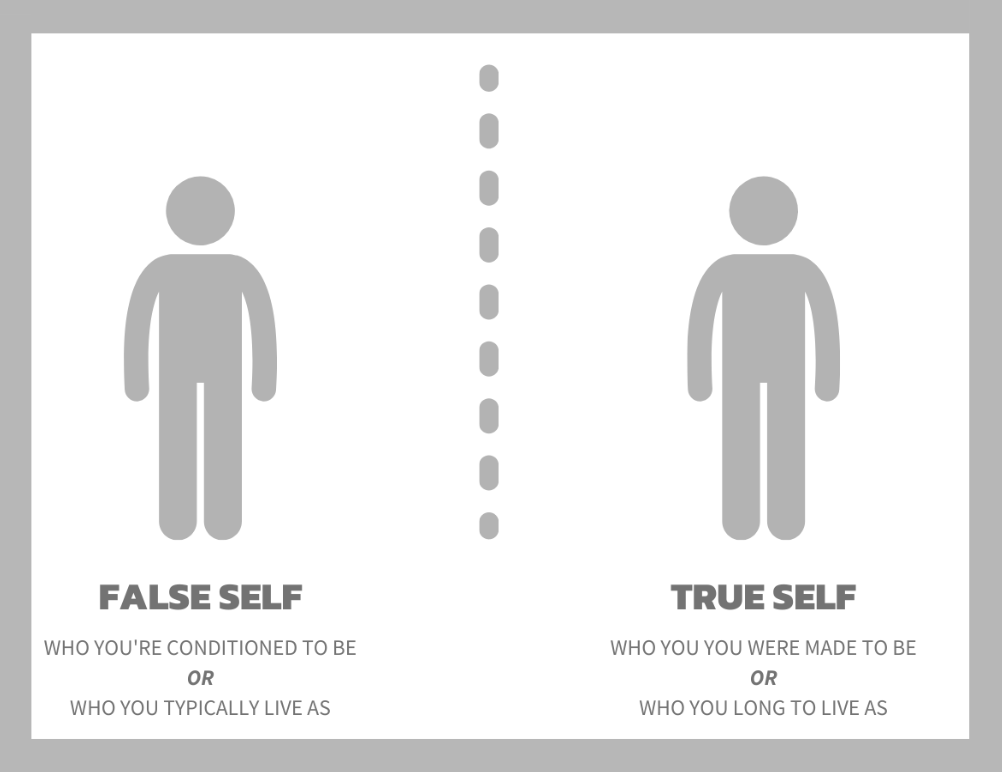
If you’re wondering what the dotted brick wall in the picture represents, you’re actually well on your way to experiencing more of the true self. The wall represents the various things that hold you back from becoming your aspirational self. One little brick of the wall might be your fear of failure, while another brick could be a tendency you’ve had in relationships ever since your last relationship ended with a train wreck and an unbelievably broken heart. Another brick may be a lie you’ve believed because of somebody’s off-handed comment in middle school, while another brick could be your inner critic warning you to not take risks after what happened at work last week. The number of things those bricks could be are almost innumerable.
The beautiful thing about today and tomorrow is that you can literally zoom out (or zoom in depending on how you look at it) and begin to piece together the things that keep you from becoming who you feel like you were made to be. Little by little - and brick by brick - you can tear down the barrier between your false self and true self. All you have to do is start asking yourself some honest questions surrounding the overarching question of “WHAT BUILDS THE WALL?” Using the list of various factors below can be a great way to start the process:
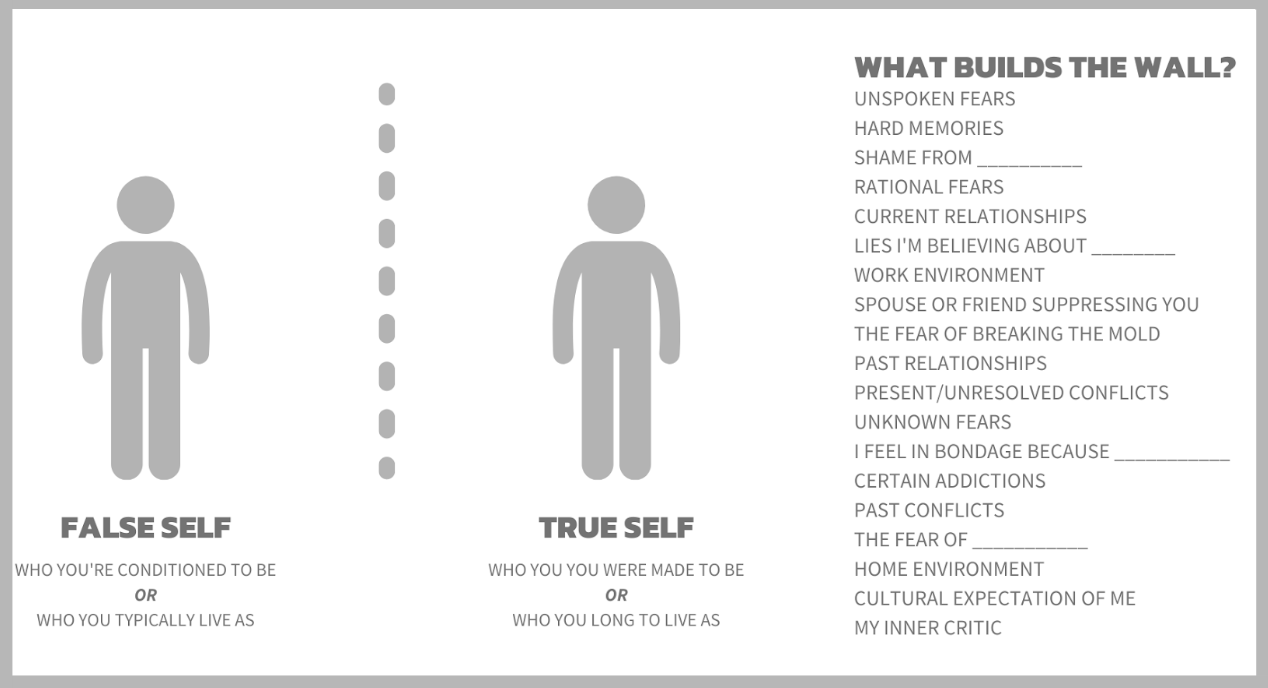
Once you’ve landed on a word or phrase that jumps out at you from the list on the right, begin to “get curious” about why that item may be a brick in the wall that separates you from experiencing your true self. For example, if one of the bricks in my wall between my false self and true self is a fear of breaking the mold, I can immediately start asking myself questions about why I’m so afraid of coming across as different or unique.
Is it an issue of being culturally non-traditional?
Is it a matter of others' perception of me?
Or… is it a matter of a personal expectation of myself to be consistent and predictable?
In my case, all of these questions begin to help me understand why I don’t want to break the mold and help me (1) acknowledge the fear, (2) understand that the fear probably isn’t irrational or without reason, and (3) learn how I may move past the fear to experience the person I sense I’ve been made to be. Make sense?
My hope for you would be that figuring out what builds the wall wouldn’t be an overwhelming thing, but a journey worth taking because little-by-little with today and tomorrow, we truly can learn so much about ourselves if we start to do the work. That said, use these simple pictures above and the few questions below to start your adventure of learning to become the person you’ve longed to be.
What are the various things that seem to create the barrier between you and your true self in your life?
Why might these sorts of things exist as realities that keep you from being who you long to be?
How might you be able to begin reminding yourself of what’s true, showing compassion toward yourself for what you feel, and move toward change through honesty and reflection?
Who could you begin to process the “bricks” with and help walk with you as you journey ahead?
By Nick Sweerin, Restorative Mentor